
The effectiveness of a retail display is reflected in how much sales it generates in relation to the space it occupies and the investment behind it. It is not just a visual element, but part of the store’s overall sales performance.
Effectiveness is evaluated by looking at sales, product turnover, and customer behavior around the display. These indicators reveal whether the display actually performs or simply looks good.
What does display effectiveness mean in practice?
An effective display does three things: it stops the customer, directs attention to the product, and leads to a purchase.
In practice, this means the display stands out from its surroundings, is easy to understand at a glance, and makes the buying decision simple. If the customer has to think too much, the display is not working.
Product selection plays a key role. Too wide a range scatters attention, while too narrow a selection limits choice. A well-functioning display is clear, focused, and adapts to seasonality and demand.
Which metrics are used to evaluate performance?
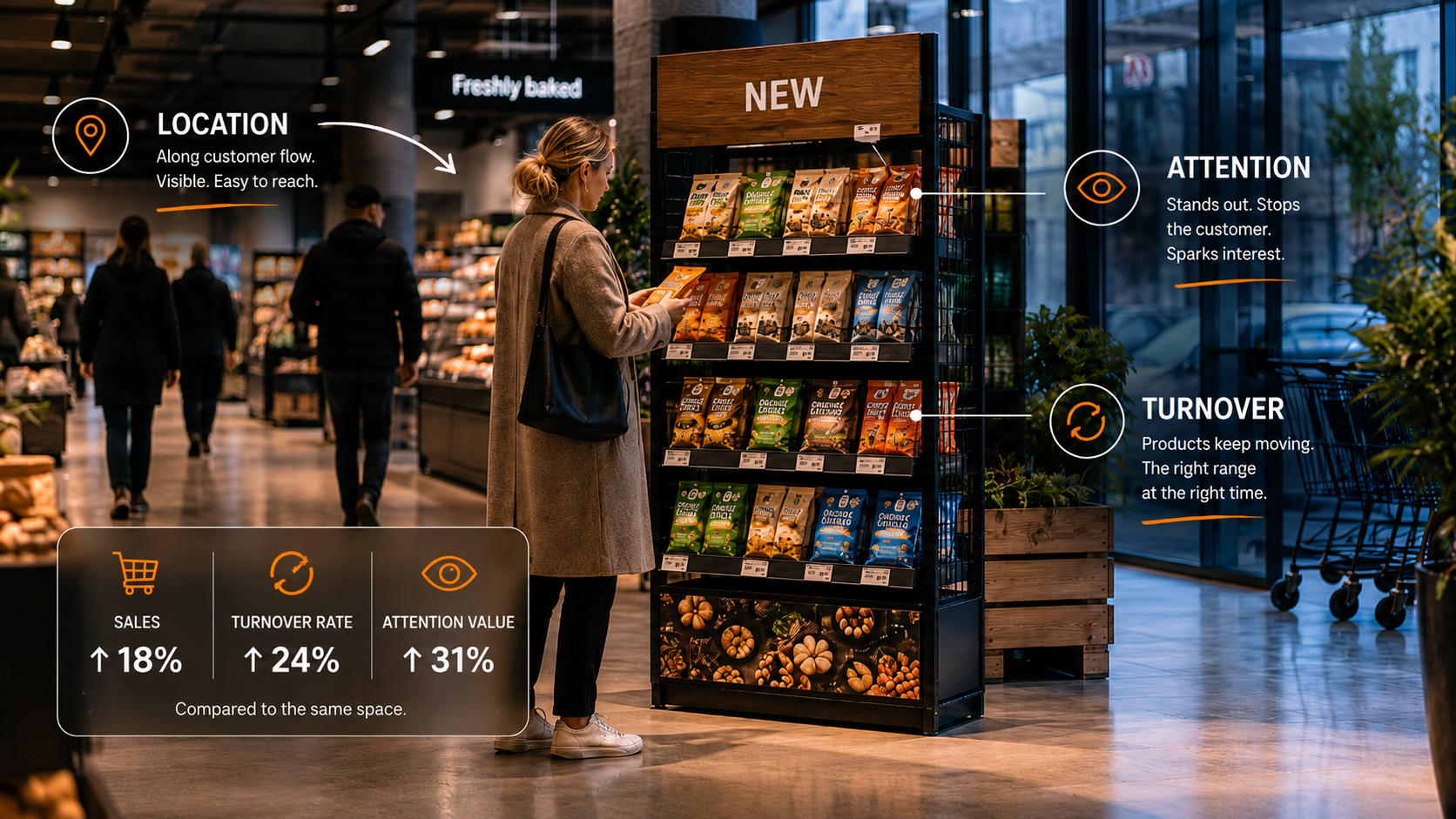
Effectiveness should be monitored from three perspectives: sales, turnover, and attention.
Sales show directly whether the display performs. What matters is not only total sales, but sales relative to the space used. A good display generates more sales than an equivalent amount of shelf space.
Turnover indicates how quickly products move. Fast turnover suggests that the selection and pricing are right. Slow turnover often points to issues in product choice, placement, or presentation.
Attention is visible in customer behavior. Do customers stop, engage with the products, or walk past? This often reveals problems before they show in sales figures
How does location affect results?
Location often matters more than the display itself.
The best placements are along customer flow: near entrances, at aisle intersections, and close to checkout areas. These locations maximize visibility and customer contact.
Poor placement can make even a good display invisible. Back areas, hidden corners, and congested zones quickly reduce effectiveness.
How can display performance be improved?
Improvement is not a one-time fix, but continuous refinement.
The biggest impact usually comes from three factors:
- visual clarity
- the right product selection
- effective placement
The display must be easy to read. The customer should immediately understand what is offered and why it matters.
Product selection should be updated regularly. New arrivals, seasonal products, and campaigns keep the display relevant. At the same time, performance data reveals what works and what does not.
Small changes can have a big impact. Product arrangement, pricing communication, or placement can determine whether a customer stops or walks past.